REAL or FAKE: Liam Payne Autographed 8×10 Signed Photo

Sep
Authenticating celebrity autographs is considerably more complicated than simply asking whether a signature “looks right.”
For collectors of Liam Payne autographs and One Direction memorabilia, this is particularly important. Like many celebrities who signed thousands of photographs, albums, posters, and other memorabilia throughout their career, Liam Payne’s signature can show natural variation depending on the year, signing environment, writing instrument, surface, and speed at which he was signing.
That means a signature that looks different from another authentic example isn’t automatically fake.
However, there are certain characteristics collectors can examine when determining whether an autograph deserves further authentication.
This article examines the visual characteristics that professional autograph authenticators consider when reviewing a questionable signature, including stroke direction, signature structure, pen movement, loops, crossings, terminal flourishes, and overall signing rhythm.
Why Comparing Two Autographs Isn’t as Simple as “They Look Different”
One of the most common mistakes collectors make is comparing two signatures and assuming that authentic signatures should be virtually identical.
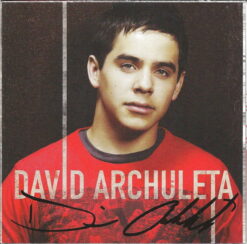
That’s not necessarily the case. A celebrity may sign:
- Quickly while meeting fans
- Slowly during a private signing
- With a Sharpie
- With a ballpoint pen
- On glossy photographic paper
- On matte paper
- On an album
- At an unusual angle
- While standing or moving
- After signing hundreds of items
All of these factors can affect the appearance of a signature.
Professional authentication therefore focuses less on whether two signatures are identical and more on whether the underlying writing characteristics and motor patterns are consistent.
All of these factors can affect the appearance of a signature.
Professional authentication therefore focuses less on whether two signatures are identical and more on whether the underlying writing characteristics and motor patterns are consistent.






What Should Collectors Look for in a Liam Payne Autograph?
When examining a questionable Liam Payne signed photograph, several areas deserve particular attention.

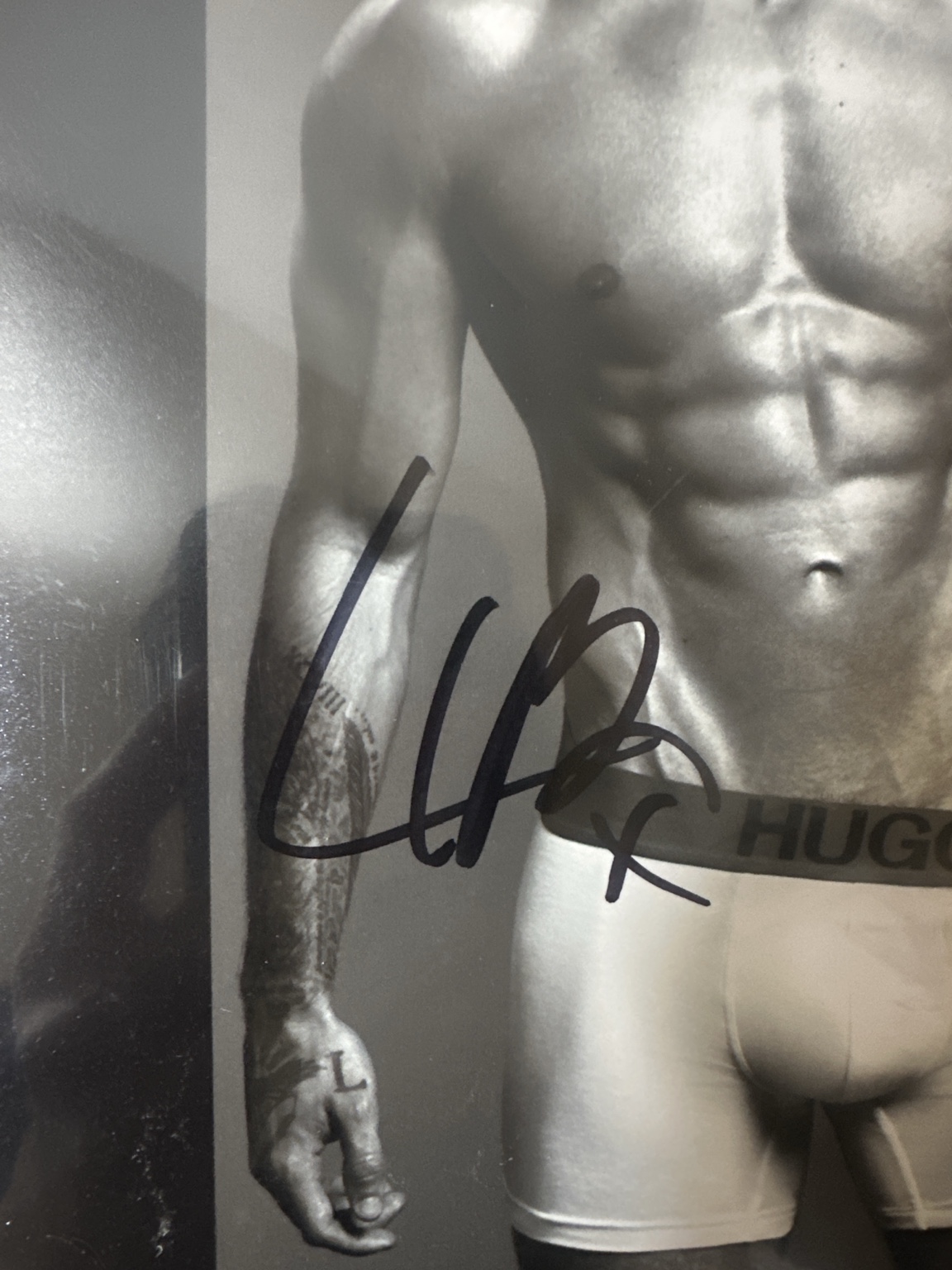
1. Examine the Initial “L”
The first letter is often one of the most useful areas for comparison.
In Liam Payne’s signature, the initial portion can be highly stylized. Collectors should examine:
- The direction of the initial stroke
- The length of the vertical or diagonal movement
- Where the pen changes direction
- The shape of the lower sweep
- Pressure changes throughout the stroke
- How naturally the initial letter transitions into the remainder of the signature
Watch for unnatural hesitation
An isolated ink blemish doesn’t mean an autograph is fake.
Ink can pool, Sharpies can skip, and glossy photographs can cause unexpected variations.
However, an authenticator may pay closer attention when an apparent blemish occurs alongside a hesitation, unnatural stopping point, or change in direction.
The important question isn’t:
“Is there a blemish?”
It’s:
“Does the movement surrounding the blemish appear consistent with natural writing?”
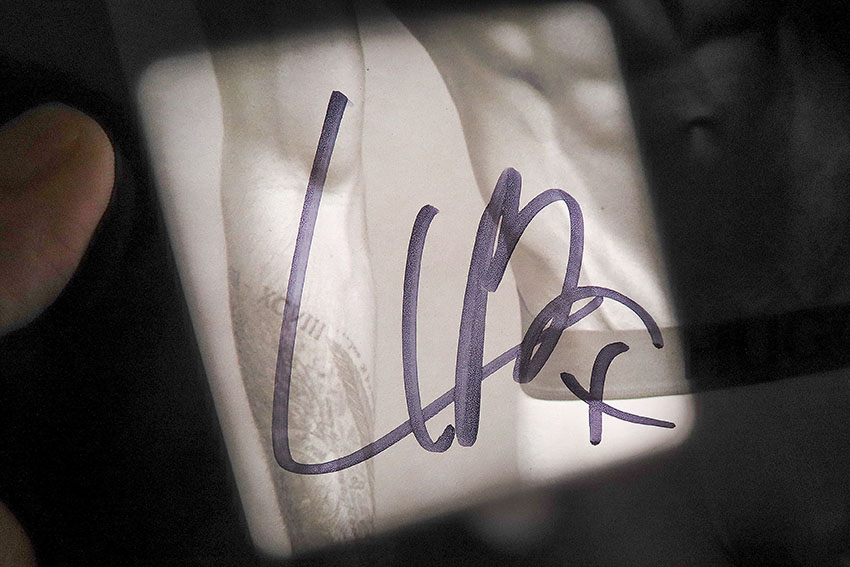
2. Analyze the Horizontal Sweep
Another important feature is the movement that follows the initial “L.”
A practiced signature normally develops a recognizable rhythm.
Collectors can examine whether the sweep:
- Moves naturally across the photograph
- Maintains consistent momentum
- Shows natural pressure variation
- Connects smoothly with the next character
- Contains unusual stops or direction changes
A slightly shaky line isn’t necessarily suspicious. In-person signatures are frequently messy.
The concern becomes greater when multiple portions of the signature appear hesitant or mechanically constructed.
3. Examine the Second Major Stroke
The next major stroke is another useful comparison point.
In a highly abbreviated celebrity signature, individual letters may become almost impossible to identify. That’s normal.
Instead of asking:
“Does this look like the letter I?”
an authenticator may ask:
“Does the direction and movement of this stroke correspond with known authentic examples?”
For Liam Payne, collectors should compare the direction of the second major stroke, the size of its loop, and the way it returns into the rest of the signature.
A signature can contain unusual loops and still be genuine.
The concern arises when the construction of those loops consistently differs from reliable authenticated examples.
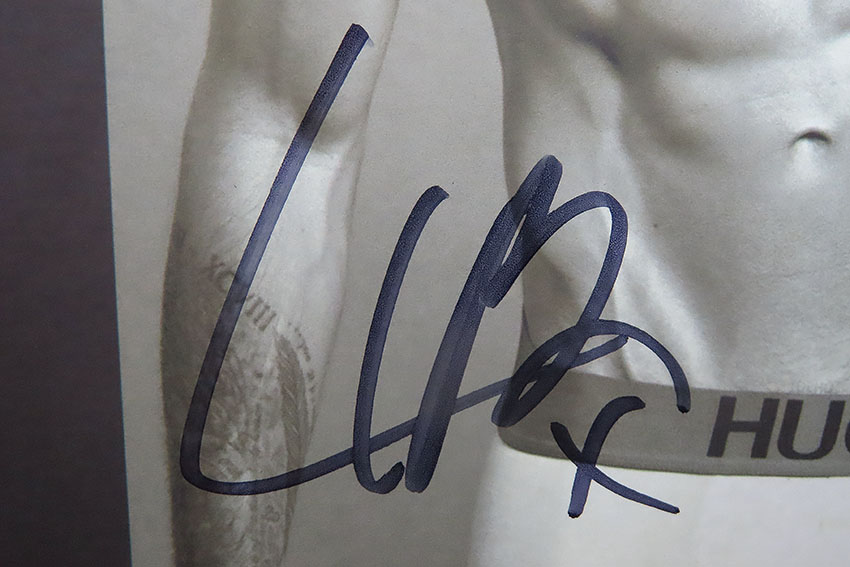
4. The “B” or Large Loop Issue
One particularly interesting feature in some questionable Liam Payne signatures is the appearance of a large loop structure that can visually resemble a capital B.
At first glance, a collector might interpret this as another letter.
But autograph authentication isn’t necessarily concerned with whether the signature can be read as the person’s name.
In fact, many celebrity signatures are extremely abbreviated.
Instead, the important question is whether the shape was produced naturally through the same habitual movement used by the signer.
A large loop should therefore be compared for:
- Size
- Direction
- Entry stroke
- Exit stroke
- Relationship to neighboring strokes
- Position within the overall signature
If these characteristics consistently differ from authenticated examples, the discrepancy becomes more significant.
5. Look Closely at Crossovers
Crossovers are particularly valuable when examining an autograph.
When one stroke crosses another, an authenticator may examine the physical ink under magnification to determine whether there is evidence of stroke sequencing.
For example:
Stroke A → Stroke B
versus
Stroke B → Stroke A
In some circumstances, the interaction between the inks can provide clues about which stroke was applied first.
This is one reason a high-quality photograph can be useful for preliminary examination, but physical examination remains superior.
Collectors should never assume they can determine stroke order conclusively from a standard JPEG photograph.
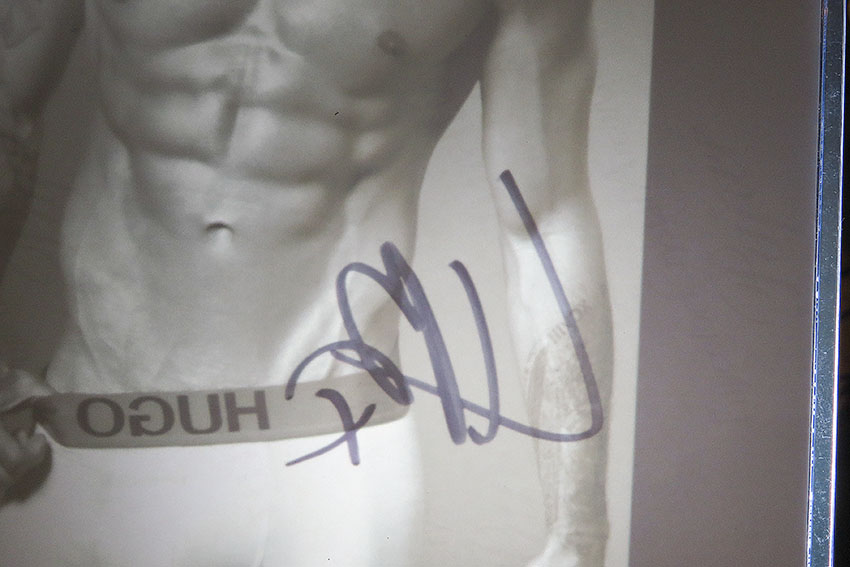
6. The Final “X” and Terminal Flourish
The ending of a signature can be one of its most distinctive characteristics.
In the example examined for this article, the autograph contains an X-like terminal element with a downward extension.
This raises several useful authentication questions:
- Which stroke appears to have been made first?
- Does the signer normally cross the element in the same direction?
- Is the terminal flourish consistent in shape?
- Does the signature normally finish with an upward or downward movement?
- How far does the final stroke extend beyond the rest of the signature?
However, collectors should be careful about establishing absolute rules.
For example, saying:
“Liam Payne always draws the left side of the X first.”
would require a sufficiently large population of authenticated examples to substantiate.
A professional authenticator would instead compare multiple authenticated signatures and determine whether a consistent pattern exists.
7. Signature Direction and Motor Rhythm
One of the most important concepts in autograph authentication is motor rhythm.
A person’s signature isn’t simply a collection of lines.
It is a habitual physical movement.
Authenticators may consider:
- Starting point
- Direction of travel
- Speed
- Pressure
- Letter formation
- Loops
- Crossovers
- Changes in direction
- Terminal strokes
This is why two signatures can look superficially similar while being produced through very different movements.
Conversely, two authentic signatures can look quite different while still sharing the same underlying motor characteristics.
This distinction is critical.
Visual similarity alone does not establish authenticity.
And visual differences alone do not necessarily establish forgery.

What Makes a Signature More Concerning?
When examining a questionable Liam Payne autograph, individual imperfections shouldn’t necessarily be treated as evidence of forgery.
Instead, collectors should look for multiple independent inconsistencies.
For example:
Initial stroke differs
↓
Second stroke differs
↓
Loop construction differs
↓
Crossover differs
↓
Terminal flourish differs
When several structural characteristics deviate from authenticated examples, the autograph deserves substantially more scrutiny.
The Importance of the Original Listing Photograph
There is another issue that collectors should not overlook when purchasing autographs online.
What if the autograph you receive isn’t the autograph shown in the listing?
This is fundamentally different from simply receiving a signature that looks different from another Liam Payne autograph.
If an eBay seller photographs a specific signed photograph and the physical item delivered to the buyer contains a materially different autograph, the buyer should document that discrepancy immediately.
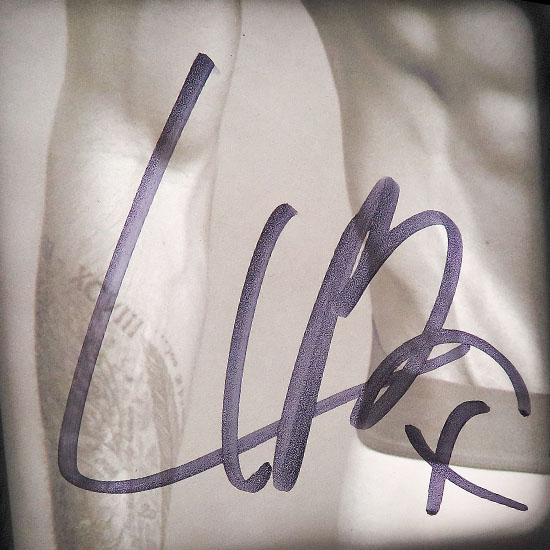
Take screenshots of:
- The original listing
- The seller’s photograph
- The autograph on the received item
- The item description
- The order information
- Any communication with the seller
The issue can then be presented objectively:
“The autograph on the item received does not match the autograph shown in the seller’s listing.”
That is a much stronger factual statement than immediately alleging that the autograph is counterfeit.
PSA, JSA and Beckett: What Professional Authentication Looks At
Professional authentication services such as PSA/DNA, James Spence Authentication (JSA), and Beckett Authentication Services (BAS) evaluate autographs using more than a simple visual resemblance test.
Depending on the service and item, authentication may involve:
- Comparison with known authentic exemplars
- Signature structure
- Writing characteristics
- Ink examination
- Object examination
- Physical inspection
- Provenance
- Specialized equipment when appropriate
The goal is to determine whether the autograph is consistent with the known signing characteristics of the individual.
That is fundamentally different from simply asking whether a collector personally “likes the signature.”
A Preliminary Examination of a Questionable Liam Payne Autograph
Using the methodology described above, a questionable Liam Payne autograph can be summarized objectively as follows:
Initial “L”
Area requiring examination:
The initial stroke may demonstrate irregular line quality, an unusual termination, or apparent ink irregularity.
Horizontal sweep
Area requiring examination:
The movement across the photograph may exhibit wavering or inconsistent execution that should be compared against authenticated examples.
Second major stroke
Area requiring examination:
The direction, curvature, and return movement should be compared with established Liam Payne exemplars.
Central loop structure
Area requiring examination:
A prominent loop can create a visual resemblance to a capital “B.” Its structure, direction, and connectivity should be evaluated against authenticated examples.
Crossovers
Area requiring examination:
Multiple overlapping strokes provide an opportunity for physical ink examination and potential determination of stroke sequencing.
Terminal X/flourish
Area requiring examination:
The final crossing strokes and downward extension should be compared against authenticated examples for directionality, proportions, and finishing movement.
Overall rhythm
Most important consideration:
The autograph should be evaluated as a complete motor pattern rather than as a collection of isolated letters.
Final Thoughts for Collectors
The authentication of celebrity autographs requires more than recognizing a person’s name.
For collectors purchasing a Liam Payne signed photo, the safest approach is to evaluate the entire transaction:
Signature + photograph + provenance + seller + listing + authentication
rather than relying on any single factor.
An autograph that contains one unusual stroke may simply represent natural variation.
An autograph containing multiple structural inconsistencies, particularly when those inconsistencies are also present when comparing the physical item against the seller’s listing photograph, deserves much closer examination.
And when significant doubt remains, professional authentication is the appropriate next step.
The golden rule of autograph collecting:
Don’t authenticate a signature based on one feature. Look for the pattern.
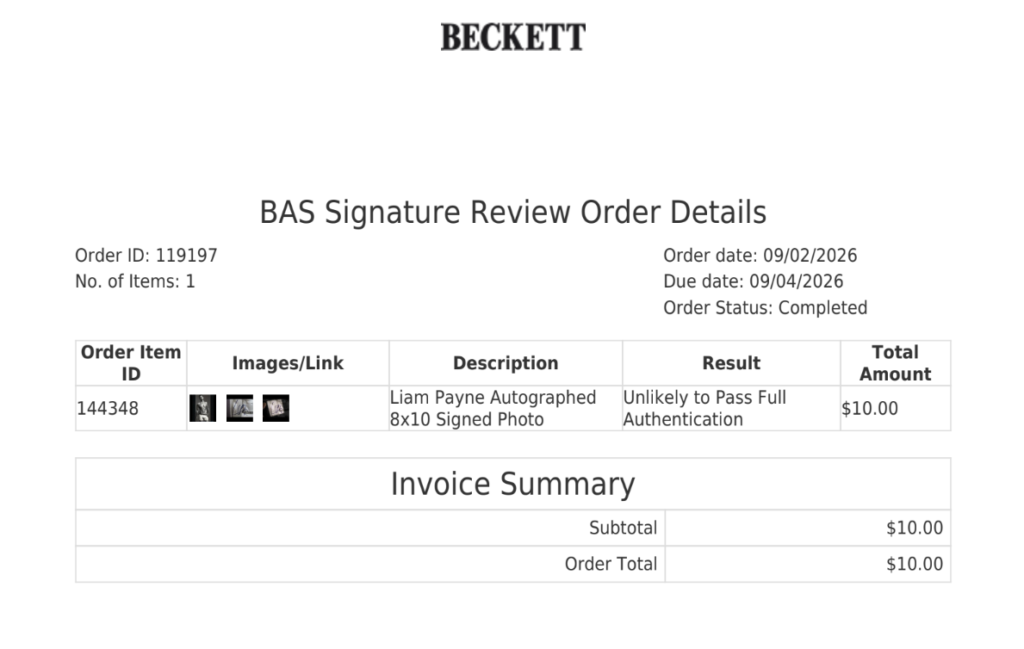
Important: This article is an educational analysis and is not an official authentication opinion from PSA, JSA, Beckett, Grad Authentication, or any other professional authentication company. A definitive authentication determination requires examination of the physical item and comparison against appropriate authenticated exemplars.